Amir Günther · 28 October 2026
Remote sensors now map root system responses to shifting tides in northern Germany's coastal woodlands
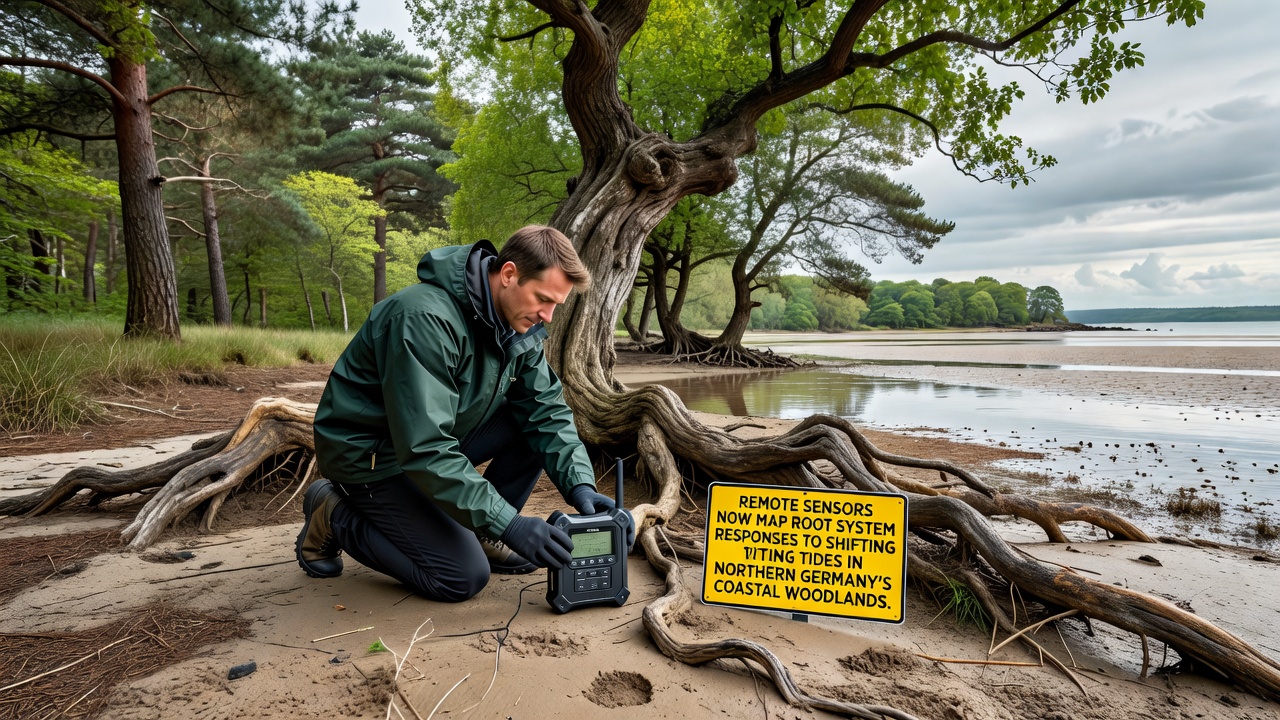
Remote sensors now track how tree roots in northern Germany's coastal woodlands react to changing tidal patterns, and researchers have placed networks of these devices across sites in Schleswig-Holstein and Mecklenburg-Vorpommern since early 2025. The equipment measures soil salinity, moisture levels, and root respiration rates at depths ranging from 20 to 80 centimeters, while tidal gauges record water level fluctuations every 15 minutes. Data streams flow to central servers where algorithms flag periods when roots encounter increased saltwater intrusion during spring and autumn high tides.
Sensor networks and measurement methods
Teams from regional research institutes installed piezometers alongside capacitance probes that detect changes in electrical conductivity caused by salt ions, and these instruments transmit readings through low-power wide-area networks that operate reliably in remote woodland settings. In October 2026 additional units were added near the Elbe estuary to capture responses during equinox tides when water levels often exceed mean high water by 30 to 50 centimeters. The combined dataset now covers more than 18 months and reveals that alder roots maintain oxygen uptake even when soil saturation lasts 12 to 18 hours, whereas oak roots show reduced respiration after only six hours of inundation.
Scientists cross-reference sensor output with drone-based multispectral imagery that highlights canopy stress signals, and the paired records allow them to correlate below-ground physiology with visible foliage changes. Calibration checks performed every quarter confirm that probe accuracy remains within two percent for salinity and five percent for moisture across the full tidal cycle.
Observed root responses in different species
Along the Baltic coast near Rostock, sensor arrays documented that birch roots extend lateral growth toward less saline pockets within 48 hours after a high-tide event, while deeper taproots of pine species remain largely inactive during the same period. In contrast, sites along the North Sea near Husum show that willow roots tolerate repeated salinity spikes above 15 parts per thousand by increasing aerenchyma tissue formation, a structural adaptation visible in soil core samples taken alongside the sensors. These patterns emerge consistently across 14 monitored plots that together represent 2.3 hectares of mixed deciduous and coniferous stands.
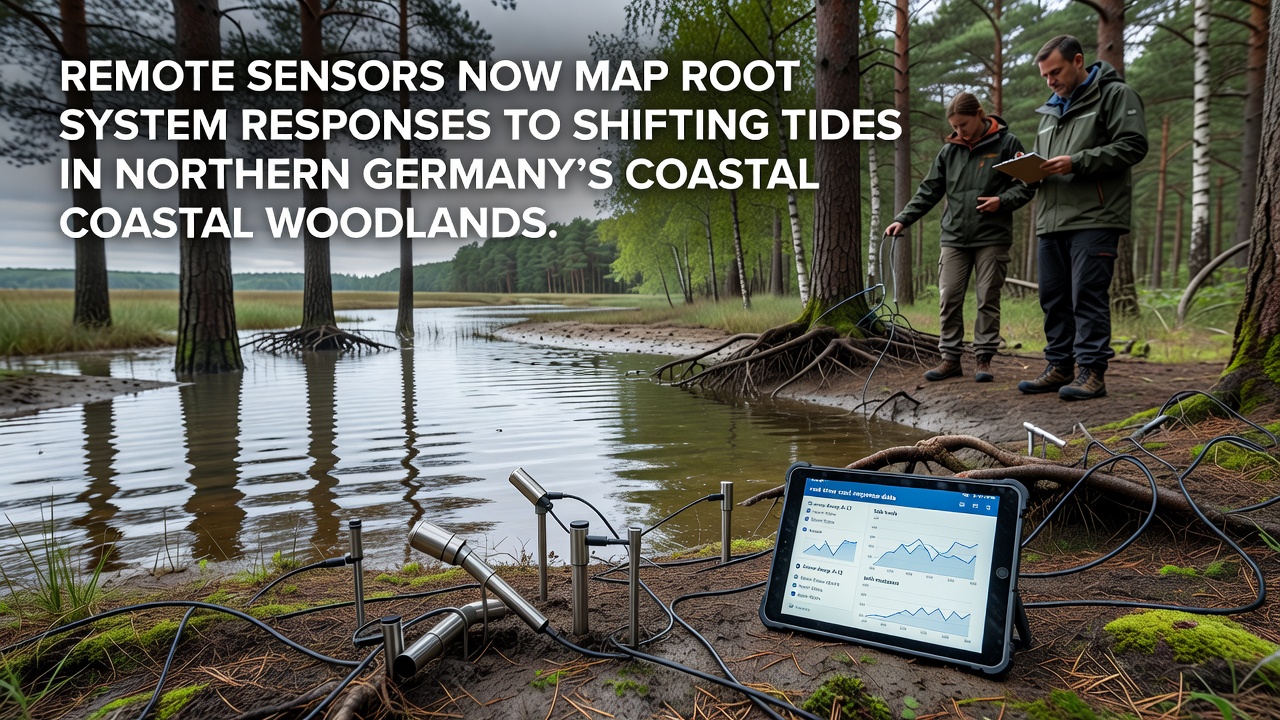
Researchers note that seasonal temperature shifts modulate the speed of these responses, with warmer autumn waters accelerating salt diffusion into the root zone by up to 25 percent compared with spring conditions. The continuous records also capture recovery phases when rainfall flushes salts downward, allowing respiration rates to rebound within three to five days after the tide recedes.
Integration with broader coastal monitoring
Regional authorities incorporate the root-system data into existing habitat mapping programs that already track bird populations and plant community shifts, and the combined information supports updates to conservation plans for areas designated under the EU Habitats Directive. A 2024 report from the European Environment Agency outlines similar sensor applications in Danish and Dutch coastal forests, providing a comparative baseline that highlights faster root adaptation rates in German sites where tidal amplitudes are larger. European Environment Agency coastal monitoring summaries further indicate that such integrated datasets improve predictions of woodland retreat under projected sea-level scenarios through 2050.
Local forestry offices use the sensor alerts to schedule selective thinning that reduces competition for water during prolonged inundation periods, and early results suggest these interventions help maintain canopy cover in stands where root stress previously led to 15 percent mortality over five years. Parallel studies at the University of Greifswald examine microbial communities associated with stressed roots, and preliminary findings link increased methane production in saturated soils to reduced root oxygen leakage.
Data processing and future extensions
Processing pipelines filter noise from tidal surges and temperature swings before feeding cleaned values into machine-learning models that forecast root stress up to 72 hours ahead. Validation against manual root excavations conducted in spring and autumn confirms model accuracy above 80 percent for major species. Plans announced in late 2026 call for expansion of the network to include acoustic sensors that detect root growth sounds, adding another layer of real-time observation without further soil disturbance.
Cross-border collaboration with Polish and Swedish research groups now shares standardized protocols, allowing direct comparison of root responses across the southern Baltic region. The resulting maps identify priority zones where root systems buffer against erosion yet remain vulnerable to accelerated tidal changes.
Conclusion
Remote sensors continue to supply detailed records of how roots in northern Germany's coastal woodlands adjust to shifting tides, and the accumulating data support refined management strategies for these dynamic ecosystems. Ongoing deployments through 2027 will extend coverage to additional species and microhabitats, strengthening the evidence base for long-term coastal forest stewardship.